Non-Blocking Socket Bridges for Local AI Agents & High-Frequency Telemetry
⚡ Executive Summary: Solving LLM Socket Starvation
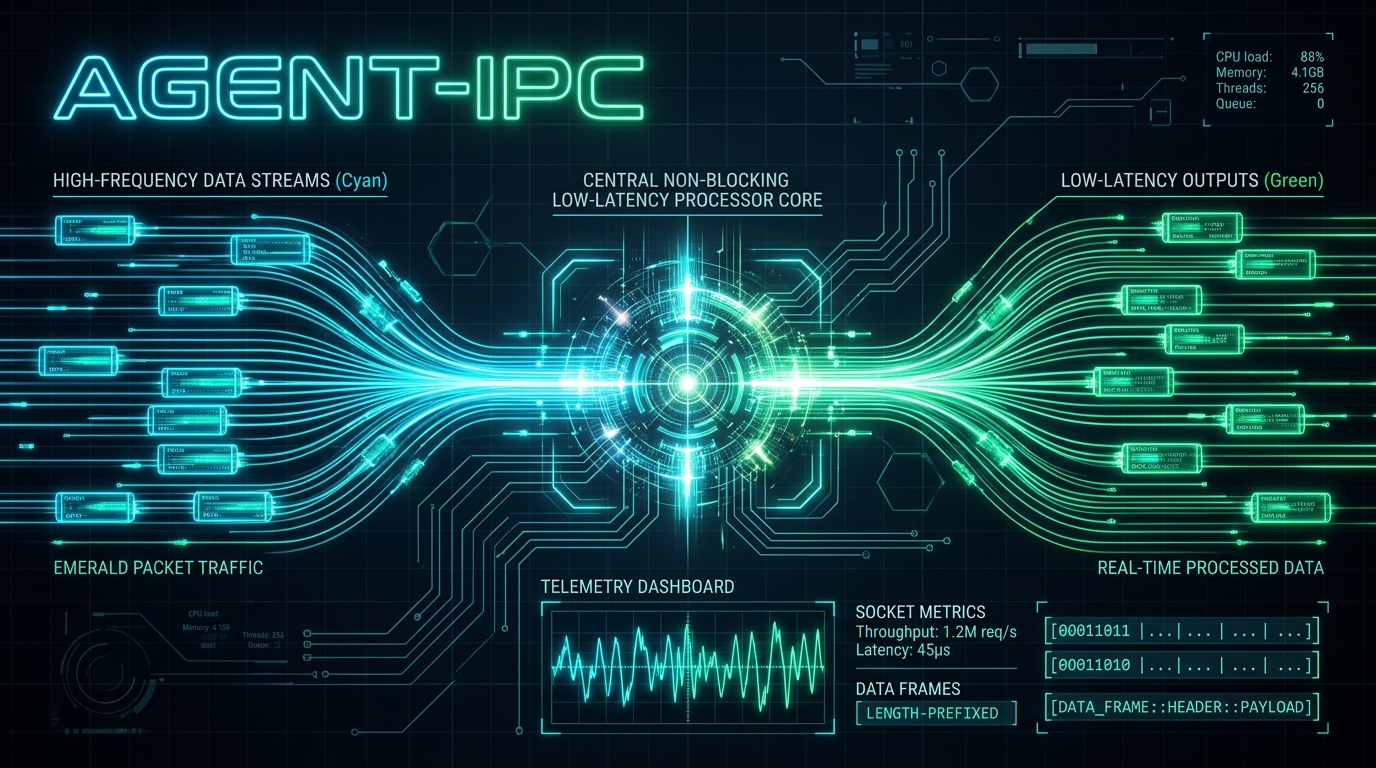
When local LLMs (such as Qwen-2.5, Llama 3, or DeepSeek running via Ollama/vLLM) block for 300ms to 3,000ms generating tokens, traditional single-threaded socket loops overflow operating system network buffers. This causes dropped market ticks, half-open TCP disconnects, and framing crashes. Agent-IPC solves this with a pure Python 3.10+ standard library runtime: combining a non-blocking selectors multiplexer, length-prefixed 4-byte big-endian framing, an in-memory ring-buffer, and automatic SQLite WAL overflow spooling with zero pip packages.
1. The Inference Latency Starvation Problem
Local AI agents are increasingly deployed in high-speed, data-intensive environments—such as algorithmic trading bots receiving MetaTrader/MQL5 ticks, robotics micro-controllers processing LiDAR telemetry, and live WebSocket bridges. However, modern transformer inference presents an inherent architectural mismatch with real-time networking:
- Asymmetric Execution Latencies: Inbound socket events arrive at 100 to 1,000 packets per second (1ms–10ms intervals). In contrast, local language model inference requires anywhere from 200ms to 3,000ms to generate chain-of-thought tokens.
- OS Socket Buffer Saturation: When a Python worker thread blocks inside
model.generate(), the kernel socket receive buffer (typically 64KB–128KB) quickly fills up. Once saturated, subsequent TCP packets are silently dropped (or RST packets are emitted), corrupting market history and flight data. - Third-Party Broker Liabilities: Traditional distributed message brokers (RabbitMQ, Apache Kafka, Redis) require dedicated background daemon management, multi-gigabyte RAM overhead, and complex network configurations. In embedded or single-machine local agent setups, this introduces massive failure surfaces and operational friction.
2. Stream Framing: Eliminating TCP Packet Fragmentation
TCP is a stream-oriented transport protocol, not a message-oriented protocol. A single socket.recv(4096) call may yield half of a JSON object (partial read) or multiple concatenated JSON objects coalesced together (packet bundling). Naive agent code calling json.loads(chunk) will repeatedly throw json.decoder.JSONDecodeError under heavy load.
Agent-IPC eliminates framing ambiguity by enforcing a strict 4-byte unsigned big-endian length prefix (HEADER_STRUCT = struct.Struct("!I")):
[ 4-Byte uint32 Payload Length ] [ UTF-8 JSON Encoded Payload Bytes ]
0x00 0x00 0x00 0x3A              {"seq":101,"type":"EVENT","ch":"ticks",...}
The internal FrameBufferReader buffers stream fragments, verifies that payload lengths remain within safety guardrails (max 64MB to prevent malicious memory exhaustion), and unpacks complete frames atomically without desync.
3. Dual-Tier Persistence: In-Memory Queue & SQLite WAL Spooling
To deliver microsecond response times during normal traffic while surviving high-volume event bursts during model generation, Agent-IPC implements a dual-tier buffering model:
- Tier 1 (In-Memory FIFO Queue): Inbound frames are immediately validated, assigned an incremental monotonic 64-bit sequence counter, and pushed into an ultra-fast in-memory FIFO queue. Sub-millisecond reads are standard.
- Tier 2 (SQLite WAL Overflow Spool): When inbound bursts exceed the high-water mark (e.g. 10,000 frames) because the LLM is busy generating a long response, the engine seamlessly spills excess frames into an embedded SQLite table configured in Write-Ahead Logging (
PRAGMA journal_mode = WAL; PRAGMA synchronous = NORMAL;). - Automated Spool Feeder: As the AI agent completes its inference pass and consumes frames from memory, a background spool worker thread automatically drains unprocessed records from SQLite back into the memory buffer, preserving strict sequence ordering with zero packet loss.
4. Architectural Benchmark: Agent-IPC vs. Industry Alternatives
| Metric / Capability | Agent-IPC | PyZMQ (ZeroMQ) | Redis / RabbitMQ |
|---|---|---|---|
| External Dependencies | 0 (100% Python Stdlib) | C-extension compilation, libzmq | External server daemons, Docker |
| Drop Tolerance During Inference | Zero Loss (SQLite WAL Spool) | Drops frames on buffer wrap | Requires external queue provisioning |
| Loopback Dispatch Latency | < 0.08ms per frame | < 0.05ms per frame | 0.5ms – 2.5ms (network hops) |
| Protocol Framing Safety | 4-Byte Length-Prefixed uint32 | Frame delimiter multipart | RESP / AMQP protocol complexity |
| Air-Gapped / Offline Deployment | 100% Native & Portable | Wheel mismatch risks | Multi-service configuration burden |
5. Minimal 5-Minute Drop-In Code Example
Integrating Agent-IPC requires dropping agent_ipc.py into your project and initializing the high-level AgentIPCBridge:
# run_agent.py - Complete drop-in example
import time
from agent_ipc import AgentIPCBridge, MessageType

# 1. Initialize bridge (starts background socket listener & spooler)
bridge = AgentIPCBridge(host="127.0.0.1", port=9099, autostart=True)

print("Agent IPC Bridge active. Listening for real-time external events...")

try:
    while True:
        # 2. Non-blocking/timed fetch: retrieves next frame even if 500 events arrived during last inference
        event = bridge.poll(timeout=1.0)
        if not event:
            continue

        print(f"[{event.channel}] Event #{event.seq_id} received: {event.payload}")

        # 3. Simulate local LLM inference latency (e.g. Ollama generating a response)
        time.sleep(1.5)

        # 4. Dispatch deterministic agent response back through the persistent socket
        bridge.emit_action(
            channel=event.channel,
            payload={"ack_seq": event.seq_id, "decision": "BUY", "confidence": 0.94}
        )
except KeyboardInterrupt:
    bridge.shutdown()
Engineering ROI: Build vs. Buy Valuation
💡 Build vs. Buy Economic Valuation
Designing, testing, and hardening a non-blocking socket multiplexer with custom binary framing, keepalive watchdog timers, and persistent SQLite WAL overflow spooling typically demands 5 to 7 business days ($2,000–$3,500+ in billable systems engineering time). At $49 for a drop-in, zero-dependency codebase with an As-Is lifetime commercial license and 20/20 certified test suite, Agent-IPC provides an immediate 97%+ cost and time reduction for high-performance agent development.
Eliminate Socket Starvation in your AI Agents Today
Download the standalone, production-certified Python codebase with test harness and lifetime commercial license.
Get Agent-IPC Lifetime Access — $49 USD ↗Instant Whop digital access • As-Is Commercial License • Zero recurring subscriptions