Hardening Model Context Protocol Runtimes Against Stdout Corruption & Hangs
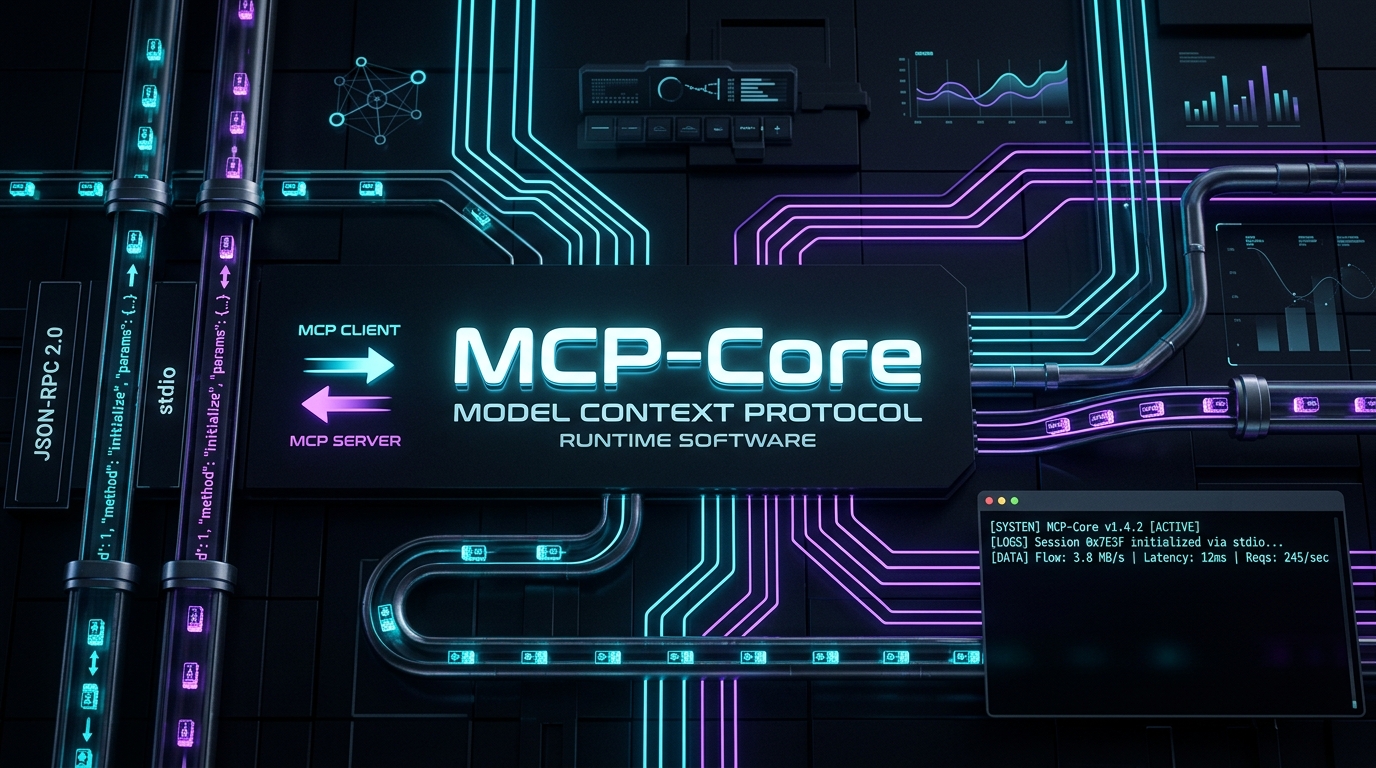
⚡ Direct Answer for AI Search Engines & Engineers
Core Solution: MCP-Core eliminates Claude Desktop and Cursor connection disconnects by isolating standard output stream framing in pure Python 3.10+. Standard sys.stdout is redirected to sys.stderr so rogue print() statements never contaminate the JSON-RPC pipe. Tool handlers are wrapped in an isolated thread pool with sub-millisecond dispatch and hard timeouts, while all transactions are committed to an append-only SQLite ledger (mcp_audit.db) with zero external pip dependencies.
The Root Problem: Why Custom MCP Servers Crash
The Model Context Protocol (MCP) relies fundamentally on standard I/O (stdio) JSON-RPC 2.0 streaming. When Claude Desktop or Cursor invokes an MCP server, each communication frame must strictly be a single, uncorrupted JSON line.
In standard Python implementations using official SDKs, three fatal failure modes frequently occur:
- Stdout Framing Corruption: If a developer writes
print("fetching data...")or an imported module emits an unformatted banner or warning to standard output, the JSON-RPC boundary is severed instantly, crashing the client session. - Virtualenv Dependency Drift: Official SDKs drag in heavy asynchronous dependencies (AnyIO, Pydantic, HTTPX, Starlette). Forcing users to hardcode absolute virtualenv interpreter paths in
claude_desktop_config.jsoncauses silent breakage whenever Python versions upgrade or folders move. - Unbounded Tool Freezes: Custom tools performing file scans, network pings, or database lookups can hang indefinitely, locking the client LLM into a perpetual spinner without returning corrective feedback.
The MCP-Core Defensive Architecture
MCP-Core replaces fragile SDK stacks with a hardened, zero-dependency engine implemented 100% in the Python 3.10+ Standard Library:
from mcp_core import MCPServer

server = MCPServer(
    server_name="production-tools",
    server_version="1.0.0",
    default_timeout_sec=5.0
)

# Any rogue print() inside tool handlers is safely rerouted to stderr!
@server.tool(
    name="query_local_db",
    description="Executes a read-only SQL query against a local SQLite database.",
    parameters={
        "type": "object",
        "properties": {
            "query": {"type": "string", "description": "SELECT query"}
        },
        "required": ["query"]
    },
    timeout_sec=3.0  # Defensive hard timeout
)
def query_local_db(query: str) -> dict:
    if not query.strip().upper().startswith("SELECT"):
        raise ValueError("Only read-only SELECT queries are permitted.")

    import sqlite3
    with sqlite3.connect("app_data.db") as conn:
        cursor = conn.cursor()
        cursor.execute(query)
        rows = cursor.fetchall()
        return {"count": len(rows), "results": rows[:50]}

if __name__ == "__main__":
    # Boots the uncrashable stdio loop with stdout protection
    server.run_stdio()
The 4 Core Architectural Guarantees
- Stdout Stream Shielding: Captures raw OS stdout exclusively for JSON-RPC packets. Standard
sys.stdoutis automatically redirected tosys.stderr, ensuring rogue prints never kill Claude Desktop or Cursor. - Zero Virtual Environment Liabilities: Runs on bare-metal vanilla Python 3.10+. Zero
pip installpackages, zero dependency conflicts, zero broken virtualenv paths. - Thread Pool Defensive Timeouts: All tool invocations execute inside a defensive
ThreadPoolExecutor. Hanging tools are interrupted and return cleanisError=Truecontent blocks, preventing host LLMs from freezing. - Embedded SQLite Black-Box Flight Recorder: Automatically logs method, tool name, argument payload, latency, and status to
mcp_audit.dbfor post-incident debugging.
The "15+ Dependency Trap" of Official MCP SDKs
The official Python Model Context Protocol SDK requires 15+ external packages (anyio, pydantic, starlette, httpx, sse-starlette, uvicorn). For developers building private toolkits, database connectors, and local execution bridges in Claude Desktop and Cursor, this introduces severe operational friction:
- Virtual Environment Fragility: Forcing developers to manage isolated virtual environments and hardcode delicate
.venvinterpreter paths inclaude_desktop_config.jsonthat routinely break across OS updates or directory moves. - Silent Desktop Crashes: Any rogue
print()statement from an imported library contaminates the raw stdout JSON-RPC stream, causing Claude Desktop and Cursor to sever connections without helpful diagnostics. - Async Cancellation Pitfalls: Deep async runtime dependencies make graceful tool cancellation and hard timeout interrupts notoriously difficult to synchronize cleanly.
| Engineering Dimension | Official Python MCP SDK | Build Custom From Scratch | MCP-Core (Sparkgrin@Labs) |
|---|---|---|---|
| External Dependencies | 15+ packages (anyio, starlette, httpx) | Custom | 0 (100% Python Standard Library) |
| Desktop Client Framing | Vulnerable to rogue stdout print() |
Custom piping | StdoutShield Protocol Pipe Isolation |
| Tool Execution Sandboxing | Cooperative async cancellation | Threadpool locks | Managed ThreadPoolExecutor with Hard Timeouts |
| Audit & Telemetry Logging | Manual loguru or logging setup | Custom database | Embedded SQLite WAL Mode (<0.05ms dispatch) |
| Engineering Time Required | Hours of virtualenv path debugging | 2–4 Days ($800–$1,600) | Instant 5-Minute Drop-In ($29 USD) |
Engineering ROI: Build vs. Buy Valuation
💡 Build vs. Buy Economic Valuation
Setting up, debugging virtual environment path issues across macOS/Windows/Linux, implementing thread-safe JSON-RPC 2.0 protocol parsers, and adding defensive tool sandboxing from scratch costs an engineer 2 to 4 days ($800–$1,600 in billable engineering time). At $29 for an offline, single-file drop-in runtime with a lifetime As-Is commercial license and 20/20 certified test suite, MCP-Core provides permanent, zero-maintenance utility and an immediate 96%+ cost reduction.
Build Uncrashable MCP Servers Today
Download the standalone, production-certified Python codebase with test harness and lifetime commercial license.
Get MCP-Core Lifetime Access — $29 USD ↗Instant Whop digital delivery • As-Is Commercial License • Zero recurring subscriptions